

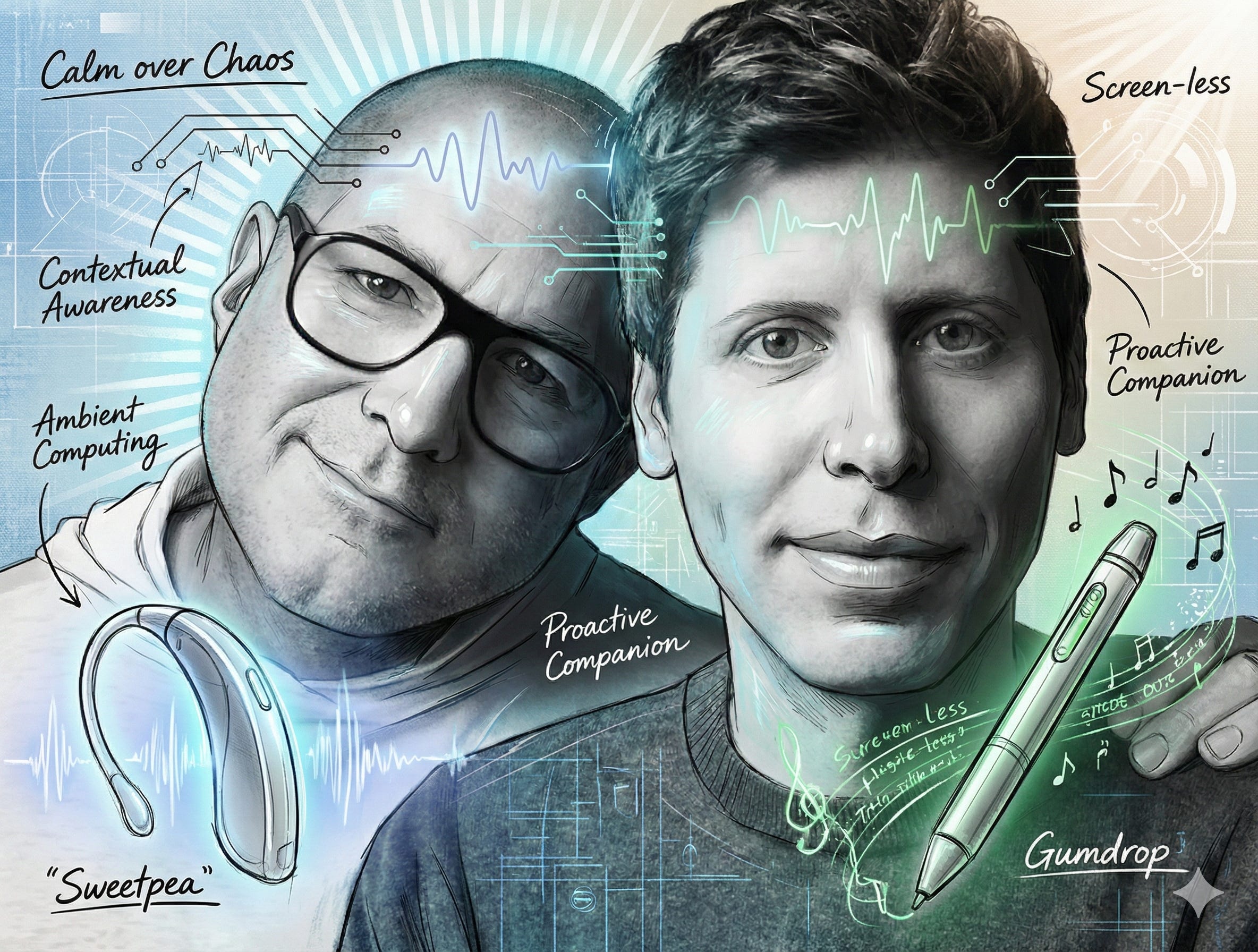
Original image from OpenAI, AI overlay from Emergent.
Jony Ive’s iPhone trained a generation to check a glowing rectangle 96 times a day. It supercharged the attention economy. And now, after a $6.5 billion acquisition in May of 2025 that brought Apple’s former hardware design leadership into OpenAI, Ive and team are building something designed to ask for less of your attention, not more. It is supposed to be a device that doesn’t sit in your pocket waiting to be pulled out, but perceives your environment and decides when to help. It engages you, not the other way around.
Nobody outside OpenAI has seen it yet. The first device is expected in the second half of 2026. But between official statements, court filings, and supply chain leaks, we know enough to understand what they’re attempting: a new category of computing that sits alongside your laptop and phone, what Sam Altman described to employees as a third core device, according to the Wall Street Journal.
Here’s what we know, what it could be, and why it matters for anyone building products.
The Vision: Calm Over Chaos
Altman keeps returning to one metaphor. Using current devices, he told an audience at Emerson Collective’s Demo Day last November, feels like walking through Times Square with flashing lights and noise. What they’re building should feel like “sitting in the most beautiful cabin by a lake and in the mountains and sort of just enjoying the peace and calm.” The OpenAI device is designed for attention liberation instead of attention capture. Altman has described a device that can filter information and understand when something is important enough to surface, and when to stay quiet, using sensors and spatial awareness to build what he called “incredible contextual awareness of your whole life.” At the same event, Altman recalled that Ive told the team early on: “We are going to make people smile. We are going to make people feel joy. Whatever the product does, it has to do that.“ At DevDay in October, Ive put it in his own terms: he hopes the devices will “make us happy and fulfilled, and more peaceful and less anxious, and less disconnected.” It’s lofty rhetoric, so let’s explore what it might be.
What It Could Be
Based on researching all the clues available in the public domain, here is what they could be building:
Sweetpea (more concrete leaks): A behind-the-ear wearable, closer to hearing aids in form factor than traditional earphones. The battery and processor sit behind the ear, enabling longer always-on use. It features a custom chip and ultrasonic transmitters that suggest environmental sensing and contextual awareness rather than just passive audio. According to leaked details first reported by TechRadar, the estimated release is near September 2026, with 40 to 50 million units expected to ship at a price point close to that of a smartphone.
Gumdrop (more speculative): A pen-shaped device that could record writing and voice notes, with ChatGPT integration to make sense of memos and discussions. Reported by TechRadar as one of three ideas under consideration, with manufacturing partners already in discussions.
Something else entirely: Every description from Altman and Ive emphasizes a new category. The device won’t be a phone. Altman told employees it isn’t glasses, adding that Ive had been skeptical about building something worn on the body. The form factor that ships may not match any current leak.
There are consistent threads across all possibilities: screen-less, proactive rather than waiting to be summoned, and designed to complement phones rather than replace them.
As Altman told Bloomberg, “In the same way that the smartphone didn’t make the laptop go away, I don’t think our first thing is going to make the smartphone go away.” Whether it’s earbuds, a pen, or a necklace, the bet is on ambient and proactive over another glowing rectangle.
No matter what it is, Altman told employees he expects to ship 100 million AI “companions,” predicting OpenAI would reach that number “faster than any company has ever shipped 100 million of something new before.“ That ambition tells us something about what they think they have, or possibly just their level of confidence!
Why This Attempt Might Be Different
AI hardware has mostly failed to win over the mass consumer market (so far). Humane’s Pin was discontinued and its assets sold to HP. Rabbit’s R1 couldn’t justify why your phone wasn’t better. The Friend pendant sparked enough public backlash that New Yorkers defaced its subway ads and organized a protest in Washington Square Park. Meta’s Ray-Ban glasses are the closest thing to a success, but even 2 million pairs sold is a long way from the 100 million promised.
The OpenAI attempt has one thing previous efforts lacked: Jony Ive, and the team he built. Ive led Apple’s industrial design team for over two decades, playing a central role in the iMac, iPod, iPhone, iPad, MacBook, and Apple Watch. Steve Jobs called him his “spiritual partner at Apple.” Tim Cook said his role in Apple’s revival “cannot be overstated.” He didn’t come to OpenAI alone. The 55-person team that joined through the acquisition includes senior Apple veterans who were responsible for shipping iPhones and Apple Watches at scale, not just designing prototypes but getting them manufactured and into hundreds of millions of hands. His team is responsible for billions of consumer device sales. That’s what $6.5 billion bought.
How We Got Here
It started in early 2023, with private dinners between Altman and Ive arranged by Airbnb CEO Brian Chesky. By September, news leaked that they were discussing AI hardware, and the Financial Times dubbed the project “the iPhone of artificial intelligence.”
In 2024, Ive assembled the team, co-founded io with Tang Tan, Evans Hankey, and Scott Cannon. He confirmed the partnership publicly in a September New York Times profile in which The Times described the project’s goal as creating “a computing experience that is less socially disruptive than the iPhone.”
In 2025, it got real. After OpenAI’s acquisition, the company almost immediately got tangled in a trademark dispute with Google-backed iyO, which was building AI-powered audio devices. The resulting court filings gave us our first clear window into the hardware work: the io team had purchased at least 30 headphone sets from various manufacturers to explore the market, and Tang Tan stated the first device would not be an in-ear or wearable device. By November, at an Emerson Collective event, Ive and Altman confirmed working prototypes exist. “I can’t believe how jaw-dropping good the work is,“ Altman said.
Then January 2026 broke the story wide open. In just three weeks, details of Sweetpea emerged from a leaker on X and were reported by TechRadar, rumors surfaced about a pen-shaped device codenamed Gumdrop via the same leaker, and OpenAI’s Chris Lehane confirmed at Davos that the first device is “on track“ for a second-half 2026 unveiling.
What This Means for Product Builders
If they succeed amid the hype, here’s what it will signal:
Contextual awareness is the next frontier. What OpenAI is building requires integrating structured data (calendars, contacts, preferences) with unstructured data (conversations, environmental perception, behavioral patterns). Large businesses have spent decades building unified views of structured data through CRMs, ERPs, and data warehouses. What OpenAI is describing adds real-world context on top: not just what’s in your database, but what’s happening in the user’s immediate environment. For product builders: what do you not know about your users’ environments and situations that would change everything if you did?
Rethink what you optimize for. The OpenAI device isn’t about less engagement. It’s a different kind of engagement: hands-off, ambient, proactive rather than reactive. Instead of maximizing time-in-app, you’d optimize for tasks completed without friction, moments where the device helped without being asked, cognitive load reduced. What would you build differently if “user didn’t have to think about it” was a success metric?
The disappearing interface. This vision has a name in design circles: calm technology. The idea that the best interface is one you forget you’re using. Current devices demand your attention constantly. The OpenAI device is designed to disappear: to handle things on your behalf without requiring you to look at a screen, tap a button, or even speak a command. If they pull it off, it’s not just a new product. It’s a new relationship with technology entirely.
Altman is betting $6.5 billion on a category that has failed repeatedly. That looks crazy until it works. The skeptics have history on their side. The believers have Jony Ive.

This article is brought to you by Productboard
Trusted by the world’s best product teams, Productboard turns customer needs into high-impact strategy in one end-to-end platform. With Productboard Spark, you can go from raw idea to polished product brief in seconds using AI that already understands your business.
See how Productboard Spark can help your product teams ship faster →
References
The Verge. Sean Hollister. “Meta’s Ray-Bans Have Sold 2 Million Pairs.” February 14, 2025.
Apple Newsroom. “Jony Ive to Form Independent Design Company with Apple as Client.” June 27, 2019.
OpenAI. “A Conversation with Sam and Jony.” DevDay 2025, October 2025.